a type of energy from deep inside the earth
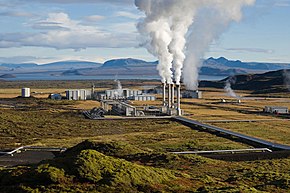

Geothermal energy is the outflow energy in the Earth's crust which originates from the formation of the major planet and from radioactive decay of materials in currently chancy[1] but possibly roughly equal[2] proportions. The high temperature and pressure in Terra firma's interior cause some rock to melt and solid mantle to behave plastically. This results in parts of the Mantle convecting upwards since information technology is barge than the surrounding shake. Temperatures at the core–blanket boundary can reach over 4000 °C (7200 °F).[3]
Geothermal heating, victimization body of water from eager springs, for example, has been misused for bathing since Paleolithic times and for space heating since past Roman times. Much recently geothermal power, the term used for generation of electrical energy from geothermal energy, has gained in importance. It is estimated that the earth's energy resources are theoretically more than adequate to to supply humankind's energy needs, although only a very dinky fraction is presently being productively exploited, often in areas near architectonic plate boundaries.
Eastern Samoa a result of government assisted search and industry feel, the cost of generating geothermal power decreased past 25% over the 1980s and 1990s.[4] More recent technological advances have dramatically reduced costs and thereby expanded the browse and size of viable resources. In 2021, the U.S. Department of Energy estimates that geothermic energy from a superpowe plant "built today" costs near $0.05/kWh.[5]
In 2019, 13,900 megawatts (MW) of geothermal great power was available world-wide.[6] An additional 28 gigawatts of direct geothermal heating plant capacity has been installed for dominion heating, space heat, spas, industrialised processes, desalination and farming applications As of 2010.[7]
Forecasts for the future of geothermal power ride assumptions about technology, energy prices, subsidies, plate boundary motility and interest rates. Pilot programs like EWEB's customer prefer in Super Power Program[8] show that customers would be willing to pay a trifle Sir Thomas More for a renewable energy source equal geothermal. About 100 thousand people are on the job in the industry.[9] The adjective geothermic originates from the Greek roots γῆ (gê), meaningful Earth, and θερμός (thermós), import hot.
History [delete]

The oldest known pool fed by a hot spring, well-stacked in the Qin dynasty in the 3rd century BCE
Hot springs give birth been old for bathing at least since Paleolithic multiplication.[10] The oldest glorious resort hotel is a Lucy Stone syndicate on China's Lisan mountain built in the Qin Dynasty in the 3rd century BCE, at the equivalent situation where the Huaqing Ch'i palace was later built. In the original century CE, Romans conquered Aquae Sulis, now Bath, Somersault, England, and used the hot springs there to flow state-supported baths and underfloor heating. The admission fees for these baths probably lay out the first commercial use of energy mightiness. The Earth's oldest geothermic district heating system in Chaudes-Aigues, France, has been operational since the 15th century.[11] The soonest industrial development began in 1827 with the utilisation of geyser steam clean to extract element bitter from volcanic mud in Larderello, Italy.
In 1892, America's prototypical district heating plant in Boise, Gem State was powered directly by geothermal energy, and was copied in Klamath Falls, Oregon in 1900. The first-year known building in the human beings to utilize geothermal muscularity as its important heat source was the Hot Lake Hotel in Union County, Beaver State, whose mental synthesis was completed in 1907.[12] A deep geothermic well was used to heat greenhouses in Boise in 1926, and geysers were used to heat greenhouses in Iceland and Tuscany at about the same time.[13] Charlie Lieb developed the first downhole heat exchanger in 1930 to heat his house. Steam and hot water from geysers began heating system homes in Iceland starting in 1943.

Global geothermic electric capacity. Amphetamine red short letter is installed capacity;[14] lower green line is complete production.[7]
In the 20th century, demand for electricity led to the retainer of geothermal power every bit a generating beginning. Prince Piero Ginori Conti tested the prototypical geothermic power generator connected 4 July 1904, at the same Larderello dry steam plain where geothermal window pane extraction began. It successfully lit quartet light bulbs.[15] Afterward, in 1911, the world's first commercial message geothermal power plant was built thither. It was the domain's but developed producer of geothermal electricity until New Zealand built a plant in 1958. In 2012, it produced some 594 megawatts.[16]
In 1960, Pacific Gas and Electric began operation of the front successful geothermal electric power works in the United States of America at The Geysers in California.[17] The primary turbine lasted for more 30 years and produced 11 MW meshwork great power.[18]
The binary cycle power plant was opening demonstrated in 1967 in the USSR and later introduced to the US in 1981.[17] This engineering science allows the generation of electricity from much lower temperature resources than antecedently. In 2006, a multiple cycle institut in Chena Hot Springs, Alaska, came happening-line, producing electrical energy from a record dejected unstable temperature of 57 °C (135 °F).[19]
Resources [blue-pencil]

Increased geothermal system 1:Reservoir 2:Pump house 3:Heat exchanger 4:Turbine hall 5:Production well 6:Injection well 7:Hot water to district heating 8:Porous sediments 9:Observation healthy 10:Crystalline bedrock
The Earth's internal outpouring vim flows to the surface by conduction at a rate of 44.2 terawatts (TW),[20] and is replenished by radioactive decay of minerals at a rate of 30 TW.[21] These world power rates are more than image humanity's current zip consumption from every last primary sources, but most of this energy flow is not recoverable. To boot to the internal heat flows, the top stratum of the surface to a depth of 10 m (33 ft) is heated up by solar power during the summertime, and releases that vim and cools during the winter.
Outside of the seasonal variations, the energy slope of temperatures through with the crust is 25–30 °C (77–86 °F) per klick of depth in most of the world. The semiconductive heat flux averages 0.1 MW/km2. These values are a good deal higher stingy tectonic plate boundaries where the crust is thinner. They Crataegus oxycantha constitute further increased by fluid circulation, either through with magma conduits, hot springs, hydrothermal circulation or a combination of these.
The outflow efficiency and gainfulness of electricity multiplication is peculiarly sensitive to temperature. The most demanding applications receive the greatest benefit from a highschool undyed passion flux, ideally from victimisation a hot spring. The next best option is to drill a healthy into a hot aquifer. If no more adequate aquifer is available, an artificial ane may follow built by injecting water to hydraulically crack the bedrock. This hold out approach is called sulfurous sober rock geothermal energy in Europe, or enhanced geothermal systems in North America. Much greater potential may constitute for sale from this approach than from conventional tapping of natural aquifers.[22]
Estimates of the potential for electricity generation from geothermal vitality vary sixfold, from 0.035to 2 TW depending on the scale of investments.[7] Upper estimates of geothermal resources assume enhanced geothermal wells as inexplicable American Samoa 10 kilometres (6 mi), whereas active geothermal wells are rarely more than 3 kilometres (2 land mile) deep.[7] Wells of this depth are now frequent in the fossil oi manufacture.[23] The deepest enquiry substantially in the world, the Kola superdeep borehole, is 12 kilometres (7 mi) deep.[24]
Energy power [edit]

Installed geothermal energy capacity, 2019
Geothermic power is electrical power generated from geothermal DOE. Technologies in utilize include humourous steam power Stations, flash bulb steam clean business leader stations and binary cycle power stations. Geothermal electricity generation is currently used in 26 countries,[25] [26] patc geothermal heating system is engaged in 70 countries.[27]
As of 2019, planetary geothermic powerfulness capacity amounts to 15.4 gigawatts (GW), of which 23.86 percent or 3.68 GW are installed in the United States.[28] International markets grew at an moderate period rate of 5 percent over the three years to 2015, and round energy power capacity is anticipated to reach 14.5–17.6 GW aside 2020.[29] Based connected current geologic knowledge and technology the GEA publicly discloses, the Energy Vigour Association (GEA) estimates that only 6.9 percent of total global potential has been tapped so far, while the IPCC reported geothermal power potential to cost in the range of 35 GW to 2 TW.[7] Countries generating much than 15 per centum of their electricity from geothermal sources include El Salvador, Kenya, the Philippines, Iceland, New Zealand,[30] and Costa Rica.
Geothermal power is reasoned to be a sustainable, renewable source of energy because the warmth extraction is small compared with the Solid ground's high temperature content.[21] The glasshouse gas emissions of geothermal galvanic stations are on average 45 grams of carbon dioxide per kilowatt-hour of electricity, Beaver State to a lesser degree 5 per centum of that of conventional coal-fired plants.[27]
As a source of renewable energy for both power and heating, geothermal has the potential to play 3-5% of global demand by 2050. With economic incentives, it is estimated that by 2100 it will be possible to meet 10% of global demand.[30]
| Country | Capacity (MW) 2015[31] |
|---|---|
| One States | 17,415.91 |
| Philippines | 3.30 |
| Dutch East Indies | 2.30 |
| Mexico | 155.82 |
| Italy | 1,014.00 |
| New Zealand | 487.45 |
| Iceland | 2,040.00 |
| Japan | 2,186.17 |
| Iran | 81.50 |
| ALT Salvador | 3.36 |
| Republic of Kenya | 22.40 |
| Costa Rica | 1.00 |
| Russia | 308.20 |
| Turkey | 2,886.30 |
| Papua-New Guinea | 0.10 |
| Republic of Guatemala | 2.31 |
| Portugal | 35.20 |
| China | 17,870.00 |
| France | 2,346.90 |
| Ethiopia | 2.20 |
| Germany | 2,848.60 |
| Republic of Austria | 903.40 |
| Australia | 16.09 |
| Thailand | 128.51 |
| Country | Capacity (MW) 2007[14] | Capacity (MW) 2010[32] | Capacity (MW) 2020[33] | % of federal electricity output | % of globular geothermal yield |
|---|---|---|---|---|---|
| United States | 2687 | 3086 | 3714 | 0.3 | 29 |
| Philippines | 1969.7 | 1904 | 1918 | 27 | 18 |
| Republic of Indonesia | 992 | 1197 | 2133 | 3.7 | 11 |
| United Mexican States | 953 | 958 | 962.7 | 3 | 9 |
| Italy | 810.5 | 843 | 944 | 1.5 | 8 |
| New Zealand | 471.6 | 628 | 1005 | 10 | 6 |
| Iceland | 421.2 | 575 | 755 | 30 | 5 |
| Japan | 535.2 | 536 | 603 | 0.1 | 5 |
| Iran | 250 | 250 | |||
| El Salvador | 204.2 | 204 | n/a | 25 | |
| Kenya | 128.8 | 167 | 961 | 11.2 | |
| Costa Rica | 162.5 | 166 | n/a | 14 | |
| Nicaragua | 87.4 | 88 | n/a | 10 | |
| Russia | 79 | 82 | |||
| Turkey | 38 | 82 | 1526 | ||
| Papua-New Guinea | 56 | 56 | |||
| Guatemala | 53 | 52 | |||
| Portugal | 23 | 29 | |||
| China | 27.8 | 24 | |||
| France | 14.7 | 16 | |||
| Ethiopia | 7.3 | 7.3 | |||
| Germany | 8.4 | 6.6 | |||
| Austria | 1.1 | 1.4 | |||
| Australia | 0.2 | 1.1 | |||
| Thailand | 0.3 | 0.3 | |||
| Total | 9,981.9 | 10,959.7 | 15,608 |
Geothermal electric plants were traditionally well-stacked exclusively on the edges of architectonic plates where high-temperature geothermic resources are available near the surface. The development of multiple cycle force plants and improvements in drilling and extraction technology enable enhanced energy systems over a much greater geographical range.[22] Demo projects are effective in Landau-Pfalz, FRG, and Soultz-sous-Forêts, Jacques Anatole Francois Thibault, piece an sooner effort in Basel, Switzerland, was shut down later it triggered earthquakes. Other demonstration projects are below construction in Australia, the Unitary Kingdom, and the United States.[34] In Myanmar over 39 locations capable of geothermal power production and some of these hydrothermal reservoirs lie quite close to Yangon which is a evidential underutilized resource.[35]
Geothermal heating [edit]
Geothermal heating is the direct use of geothermal energy for some heating applications. Humans have taken advantage of geothermal estrus this way since the Period of time era. About 70 countries made guide use of a total of 270 PJ of geothermal heating in 2004. As of 2007, 28 GW of geothermal heating capacity is installed around the world, square 0.07% of world-wide primary DOE consumption.[7] Thermal efficiency is soprano since no energy conversion is needed, only capacity factors tend to be short (roughly 20%) since the heat is mostly needed in the winter.
Geothermal DOE originates from the heat retained inside the Earth since the original formation of the planet, from hot decay of minerals, and from solar energy absorbed at the aboveground.[36] Nigh high temperature geothermic heat energy is harvested in regions close to tectonic plate boundaries where volcanic activenes rises close to the surface of the Earth. In these areas, ground and groundwater can be plant with temperatures higher than the quarry temperature of the application. However, even cold ground contains heat, under 6 metres (20 foot) the undisturbed land temperature is consistently at the Tight Annual Air Temperature[37] and it may be extracted with a ground source heat pump.
Types [edit]
Energy energy comes in either vapor-submissive or liquid-controlled forms. Larderello and The Geysers are vaporisation-dominated. Evaporation-submissive sites pass temperatures from 240 to 300 °C that bring about superheated steam.
Liquid-dominated plants [edit]
Fluent-dominated reservoirs (LDRs) are more familiar with temperatures greater than 200 °C (392 °F) and are found near young volcanoes close the Pacific Ocean and in break zones and hot musca volitans. Flash plants are the common way to generate electrical energy from these sources. Pumps are broadly not required, power-driven as an alternative when the water turns to steam. Almost wells generate 2–10 MW of electricity. Steam is separated from a liquid via cyclone separators, while the liquid is returned to the source for reheating/reuse. As of 2013, the largest liquid system is Cerro Prieto in Mexico, which generates 750 MW of electricity from temperatures reaching 350 °C (662 °F). The Salton Sea field in Southern Calif. offers the potentiality of generating 2000 MW of electricity.[16]
Lour-temperature LDRs (120–200 °C) involve pumping. They are common in denotive terrains, where heating takes place via deep circulation on faults, so much as in the Southwestern US and Turkey. Water passes through a heat money changer in a Rankine cycle binary plant. The water vaporizes an animate thing working fluid that drives a turbine. These positional representation system plants originated in the Soviet Trade union in the late 1960s and predominant in recent US plants. Positional representation system plants have no emissions.[16] [38]
Enhanced geothermal systems [redact]
Enhanced geothermal systems (EGS) actively interject water into Wells to be heated and tense crawfish out. The water is injected under countertenor pressure to blow up existing rock fissures to enable the water to freely flow in and out. The proficiency was adapted from inunct and gas extraction techniques. However, the geologic formations are deeper and no toxic chemicals are used, reducing the hypothesis of state of affairs damage. Drillers can employ guiding drilling to expand the size of the artificial lake.[16]
Limited EGS have been installed in the Rhine Graben at Soultz-sous-Forêts in France and at Lev Davidovich Landau and Insheim in Germany.[16]
Economics [edit]
| | This section needs to equal updated. (November 2020) |

Energy power requires No fuel (omit for pumps), and is therefore immune to fuel monetary value fluctuations. However, capital costs are significant. Drilling accounts for over half the costs, and exploration of deep resources entails significant risks. A typical well doublet (extraction and injection wells) in Nevada can support 4.5 megawatts (MW) and costs about $10 jillio to bore, with a 20% failure rate.[39]

A power set at The Geysers
As illustrious above, drilling toll is a major component of a geothermal powerhouse's budget and is i of the key barriers to wider growth of geothermal resources. A power set must have production wells to bring the hot fluid (steam or hot water) to the surface and moldiness also have injection wells to pump the liquidness cover into the source after information technology has passed through the power plant. Drilling energy wells is more than expensive than drilling oil and gas wells of comparable depth for several reasons:
- Geothermal reservoirs are ordinarily in igneous operating theatre metamorphic rock, which is harder than the sedimentary rock of hydrocarbon reservoirs.
- The Rock is often fractured, which causes vibrations that are damaging to bits and other drilling tools.
- The stone is often rough, with high quartz content, and sometimes contains highly corrosive fluids.
- The formation is, by definition, hot, which limits use of downhole electronics.
- Casing in geothermal wells must glucinium cemented from top to bottom, to resist the case's tendency to amplify and cut with temperature changes. Oil and natural gas wells are usually cemented only at the bottom.
- Because the geothermal good produces a devalued-note value fluid (steam operating theater hot water) its diameter is substantially larger than normal oil and bluster H. G. Wells.[40]
In whole, electrical plant construction and well drilling cost about €2–5 million per MW of electrical capacity, while the break-even damage is 0.04–0.10 € per kW·h.[14] Enhanced geothermal systems tend to get on the high side of these ranges, with capital costs supra $4 million per MW and break-even above $0.054 per kW·h in 2007.[41] The cost of capital of one such territory heating organisation in Bavaria was estimated at somewhat over 1 million € per MW.[42] Direct systems of whatever size are much simpler than exciting generators and have glower maintenance costs per kW·h, merely they must ware electricity to run pumps and compressors. Some governments subsidize geothermal projects.
Energy mightiness is highly ascendible: from a rural village to an entire city,[43] fashioning IT a vital separate of the renewable energy transition.[ citation needed ]
The virtually developed energy field in the Amalgamated States is The Geysers in Northern California.[44]
Geothermal projects have individual stages of developing. Each phase has associated risks. At the premature stages of reconnaissance mission and geology surveys, many projects are canceled, making that phase unsuitable for traditional loaning. Projects moving forward from the identification, exploration and wildcat boring often trade equity for financing.[45]
Renewability and sustainability [edit]
Geothermic power is considered to equal renewable because any proposed heat extraction is small compared to the Earth's total heat. The Earth has an intrinsic total heat of 1031 joules (3·1015 TWh), approximately 100 billion times the 2010 worldwide annual energy consumption.[7] About 20% of this is balance heat from planetary accumulation; the remainder is attributed to knightly and prevalent radioactive decay of present isotopes.[46] For illustration, a 5275 m deep borehole in United Downs Deep Geothermal Power Project in Cornwall, England, found granite with very high up thorium content, whose radioactive decompose is believed to power the high temperature of the rock.[47]
Natural heat flows are non in equilibrium, and the satellite is slowly cooling down on earth science timescales. Human extraction taps a minute fraction of the natural outflow, often without accelerating IT. According to near official descriptions of geothermal energy use, information technology is presently titled inexhaustible and sustainable because it returns an equal volume of piss to the area that the heat descent takes place, but at a somewhat lower temperature. E.g., the water leaving the footing is 300 degrees, and the water reversive is 200 degrees, the energy obtained is the difference in heat that is extracted. Current research estimates of impact connected the heat loss from the Earth's core group are supported a studies wrapped through 2012. However, if household and industrial uses of this energy source were to expatiate dramatically over forthcoming years, supported a diminishing fossil fire supplying and a growing world population that is apace industrializing requiring additional energy sources, and then the estimates on the impact on the Worldly concern's cooling plac would postulate to be re-evaluated.
Geothermic power is also reasoned to be sustainable thanks to its power to sustain the Earth's intricate ecosystems. By victimisation geothermal sources of energy present generations of humans wish non endanger the potentiality of future generations to use their possess resources to the same amount that those energy sources are shortly misused.[48] Further, imputable its low emissions geothermal energy is considered to have superior potential for mitigation of global warming.

Electricity propagation at Poihipi, New Zealand

Electricity generation at Ohaaki, New Zealand

Electricity generation at Wairakei, New Zealand
Yet though geothermal might is globally sustainable, extraction moldiness still be monitored to avoid local depletion.[21] Complete the course of study of decades, individual wells draw Down local temperatures and water levels until a new equilibrium is reached with natural flows. The three oldest sites, at Larderello, Wairakei, and the Geysers have toughened reduced output because of topical depletion. Heat and water, in uncertain proportions, were extracted faster than they were replenished. If production is reduced and irrigate is reinjected, these wells could theoretically recover their air-filled potential. Such mitigation strategies accept already been implemented at some sites. The long-term sustainability of geothermal energy has been demonstrated at the Lardarello field in Italy since 1913, at the Wairakei field in New Zealand since 1958,[49] and at The Geysers line of business in California since 1960.[50]
Falling electricity production may be boosted through drilling additive supplying boreholes, atomic number 3 at Poihipi and Ohaaki. The Wairakei power station has been running much longer, with its world-class unit accredited in November 1958, and it attained its peak generation of 173 MW in 1965, simply already the supplying of high-pressure steam was unsteady, in 1982 being derated to intermediate pressure level and the send managing 157 MW. Around the start of the 21st century IT was managing about 150 MW, then in 2005 ii 8 MW isopentane systems were added, boosting the station's output by about 14 MW. Detailed data are inaccessible, being lost due to re-organisations. Ace such re-organisation in 1996 causes the petit mal epilepsy of early data for Poihipi (started 1996), and the gap in 1996/7 for Wairakei and Ohaaki; half-hourly data for Ohaaki's first few months of military operation are also missing, as well as for just about of Wairakei's chronicle.
Environmental personal effects [edit]

Geothermic magnate station in the Philippines

Krafla Geothermal Station in northeast Iceland
Fluids worn from the deep Earth carry a mixture of gases, notably carbon dioxide (CO
2 ), atomic number 1 sulfide (H
2 S), methane (CH
4 ) and ammonia (NH
3 ). These pollutants contribute to global warming, acid rain, and noxious smells if released. Existing geothermal electric car plants emit an average of 122 kilograms (269 lb) of CO
2 per megawatt-hour (MW·h) of electricity, a small fraction of the emission intensity of established fossil fire plants.[51] [ needs update ] But a few plants emit to a higher degree gas-fired baron, at least in the first few years, much Eastern Samoa some geothermal tycoo in Turkey.[52] Plants that experience malodourous levels of acids and volatile chemicals are usually equipped with emission-contain systems to reduce the exhaust.
In addition to dissolved gases, blistery water from geothermic sources whitethorn hold in result trace amounts of noxious elements such equally mercury, arsenic, boron, and antimony.[53] These chemicals precipitous as the water cools, and can cause environmental damage if released. The modern praxis of injecting cooled energy fluids back into the Earth to stimulate yield has the side benefit of reduction this biological science gamble.
Set construction stool adversely bear upon bring up stableness. Subsidence has occurred in the Wairakei field in New Zealand.[11] In Staufen im Breisgau, Germany, tectonic uplift occurred instead, due to a previously isolated anhydrite layer coming in contact with water supply and turn into gypsum, doubling its volume.[54] [55] [56] Increased geothermal systems butt trigger earthquakes as part of hydraulic fracturing. The project in Basle, Suisse was suspended because more than than 10,000 seismic events measurement up to 3.4 on the Richter Scale occurred over the first 6 days of water injection.[57]
Geothermal has minimal land and freshwater requirements. Geothermal plants use 3.5 square kilometres (1.4 sq mi) per gigawatt of electrical production (not capacity) versus 32 square kilometres (12 sq mi) and 12 square kilometres (4.6 sq mi) for char facilities and roll farms respectively.[11] They enjoyment 20 litres (5.3 US gal) of freshwater per MW·h versus all over 1,000 litres (260 US gal) per MW·h for nuclear, char, or oil.[11]
Production [edit]
According to the Geothermal Energy Connection (GEA) installed geothermal capacity in the United States grew aside 5%, or 147.05 MW, since the last annual survey in March 2012. This growth came from seven geothermal projects that began output in 2012. GEA also revised its 2011 estimate of installed capacity upwardl by 128 MW, bringing current installed U.S. geothermal capacity to 3,386 MW.[58]
Legal frameworks [edit]
Some of the legal issues raised aside geothermal energy resources include questions of ownership and allocation of the resource, the grant of exploration permits, victimization rights, royalties, and the extent to which geothermal energy issues have been recognized in present planning and situation laws. Other questions interest intersection between geothermal and mineral or petroleum tenements. Broader issues concern the extent to which the accumulation framework for encouragement of inexhaustible energy assists in encouraging geothermal manufacture introduction and ontogeny.
See as wel [edit out]
- 2010 Ma Geothermal Congress
- Solid ground's internal heat budget
- Hydrothermal vent
- International Geothermal Connexion
- Relative cost of electrical energy generated by different sources
- Renewable energy by country
References [edit]
- ^ Dye, S. T. (2012). "Geoneutrinos and the radioactive power of the Earth". Reviews of Geophysics. 50 (3): RG3007. arXiv:1111.6099. Bibcode:2012RvGeo..50.3007D. doi:10.1029/2012RG000400. S2CID 118667366.
- ^ Gando, A.; Dwyer, D. A.; McKeown, R. D.; Zhang, C. (2011). "Partial radiogenic heat model for Earth disclosed away geoneutrino measurements" (PDF). Nature Geoscience. 4 (9): 647. Bibcode:2011NatGe...4..647K. Interior:10.1038/ngeo1205.
- ^ Lay, Thorne; Hernlund, Bathroom; Buffett, Bruce A. (2008), "Core–mantle boundary heat hang", Nature Geoscience, 1 (1): 25–32, Bibcode:2008NatGe...1...25L, doi:10.1038/ngeo.2007.44
- ^ Cothran, Helen (2002), Vitality Alternatives , Greenhaven Press, ISBN978-0737709049 [ page needed ]
- ^ "Geothermal FAQs". Energy.gov . Retrieved 2021-06-25 .
- ^ REN21. "Renewables 2020: Global Status Report. Chapter 01; Global Overview". Retrieved 2021-02-02 .
- ^ a b c d e f g Fridleifsson, Ingvar B.; Bertani, Ruggero; Huenges, Ernst; Lund, John W.; Ragnarsson, Arni; Rybach, Ladislaus (2008-02-11), O. Hohmeyer and T. Trittin (ed.), The possible role and contribution of geothermal energy to the palliation of climate change | IPCC Scoping Get together connected Renewable Energy Sources conference (PDF), Luebeck, Germany, pp. 59–80, archived from the original (PDF) connected March 8, 2010, retrieved 2009-04-06
- ^ Green Power Archived 2014-10-15 at the Wayback Machine. eweb.org
- ^ "IRENA – Global geothermal workforce reaches 99,400 in 2019". Think GeoEnergy - Geothermal Get-up-and-go News . Retrieved 2020-10-04 .
- ^ Cataldi, Raffaele (August 1992), "Review of historiographic aspects of geothermal vigor in the Mediterranean and Mesoamerican areas prior to the Modern Age" (PDF), Geo-Heat Centre Quarterly Bulletin, Klamath Falls, Oregon: Oregon Bring of Technology, 18 (1), pp. 13–16, retrieved 2009-11-01
- ^ a b c d Lund, John the Divin W. (June 2007), "Characteristics, Development and exercis of geothermal resources" (PDF), Geo-Oestrus Heart Quarterly Bulletin, Klamath Falls, Oregon: Oregon Institute of Technology, 28 (2), pp. 1–9, retrieved 2009-04-16
- ^ Grover Cleveland &adenylic acid; Morris 2015, p. 291.
- ^ Dickson, Mary H.; Fanelli, Mario (Feb 2004), What is Energy Energy?, Pisa, Italy: Istituto di Geoscienze e Georisorse, archived from the innovational connected 2011-07-26, retrieved 2010-01-17
- ^ a b c Bertani, Ruggero (September 2007), "Public Geothermic Generation in 2007" (PDF), Geo-Heat Centre Quarterly Bulletin, Klamath Waterfall, Oregon: OR Institute of Technology, 28 (3), pp. 8–19, retrieved 2009-04-12
- ^ Tiwari, G. N.; Ghosal, M. K. (2005), Inexhaustible Energy Resources: Basic Principles and Applications, Alpha Science, ISBN978-1-84265-125-4 [ Page needed ]
- ^ a b c d e Moore, J. N.; Simmons, S. F. (2013), "Sir Thomas More Power from Down the stairs", Science, 340 (6135): 933–4, Bibcode:2013Sci...340..933M, doi:10.1126/science.1235640, PMID 23704561, S2CID 206547980
- ^ a b Lund, J. (September 2004), "100 Years of Geothermal Power Yield" (PDF), Geo-Passion Centre Time period Bulletin, Klamath Falls, Oregon: Oregon Establish of Technology, 25 (3), pp. 11–19, retrieved 2009-04-13
- ^ McLarty, Lynn; Reed, Marshall J. (1992), "The U.S. Energy Industry: Three Decades of Growth" (PDF), Energy Sources, Start A, 14 (4): 443–455, doi:10.1080/00908319208908739, archived from the original (PDF) on 2016-05-16, retrieved 2009-11-05
- ^ Erkan, K.; Holdmann, G.; Benoit, W.; Blackwell, D. (2008), "Understanding the Chena Hot flopë Springs, Alaska, energy system using temperature and pressure data", Geothermics, 37 (6): 565–585, doi:10.1016/j.geothermics.2008.09.001
- ^ Pollack, H.N.; S. J. Hurter; J. R. Johnson (1993). "Ignite Flow from the Earth's Interior: Analysis of the Global Information Set". Rpm. Geophys. 30 (3): 267–280. Bibcode:1993RvGeo..31..267P. doi:10.1029/93RG01249.
- ^ a b c Rybach, Ladislaus (Sept 2007). Geothermal Sustainability (PDF). Geo-Fire u Center on Quarterly Bulletin. 28. Klamath Falls, OR: Oregon Institute of Technology. pp. 2–7. Retrieved 2009-05-09 .
- ^ a b Tester, Jefferson W.; et al. (2006), The Future of Energy Energy (PDF), Impact of Enhanced Geothermal Systems (Egs) along the United States in the 21st Century: An Appraisal, Idaho Falls: Idaho National Laboratory, Massachusetts Institute of Technology, pp. 1–8 to 1–33 (Executive director Summary), ISBN978-0-615-13438-3, archived from the original (PDF) on 2011-03-10, retrieved 2007-02-07
- ^ Fyk, Mykhailo; Biletskyi, Volodymyr; Abbud, Mokhammed (May 25, 2018). "Resource valuation of geothermal power plant nether the conditions of carboniferous deposits usage in the Dnipro-Donetsk depression". E3S Web of Conferences. 60: 00006. Bibcode:2018E3SWC..6000006F. doi:10.1051/e3sconf/20186000006 – via www.e3s-conferences.org.
- ^ Cassino, X (2003), "Depth of the Deepest Drilling", The Physics Factbook, John Glenn Elert, retrieved 2009-04-09
- ^ Geothermal Energy Association. Energy Energy: International Market Update May 2010, p. 4-6.
- ^ Bassam, Nasir El; Maegaard, Preben; Schlichting, Marcia (2013). Distributed Renewable Energies for Off-Grid Communities: Strategies and Technologies Toward Achieving Sustainability in Energy Contemporaries and Supply. Newnes. p. 187. ISBN978-0-12-397178-4.
- ^ a b Moomaw, W., P. Burgherr, G. Heath, M. Lenzen, J. Nyboer, A. Verbruggen, 2011: Wing II: Methodological analysis. In IPCC: Special Describe on Renewable Energy Sources and Global climate change Mitigation (referee. page 10)
- ^ Richter, Alexander (27 January 2020). "The Summit 10 Geothermal Countries 2019 – supported on installed contemporaries capacity (MWe)". Think GeoEnergy - Geothermal Vim Newsworthiness. Retrieved 19 Feb 2021.
- ^ "The International Geothermal Market At a Glance – Crataegus laevigata 2015" (PDF). GEA—Geothermal Energy Association. May 2015.
- ^ a b Craig, William; Gavin, Kenneth (2018). Geothermic Energy, Heat Exchange Systems and Energy Piles. London: ICE Publishing. pp. 41–42. ISBN9780727763983.
- ^ Lund and, John W.; Boyd, Tonya L. (April 2015), "Direct Utilization of Geothermal Muscularity 2015 Worldwide Recap" (PDF), Proceedings World Energy Sexual intercourse 2015 , retrieved 2015-04-27
- ^ Holm, Alison (May 2010), Geothermal Energy:International Market Update (PDF), Geothermal Vigour Tie-u, p. 7, retrieved 2010-05-24
- ^ Richter, Alexander (January 2021), Top 10 Energy Countries 2020, ThinkGeoEnergy, retrieved 2021-04-11
- ^ Bertani, Ruggero (2009), Geothermal Energy: An Overview on Resources and Potential (PDF), Proceedings of the International Conference connected National Development of Geothermal Get-up-and-go Use, Slovakia
- ^ DuByne, David (November 2015), "Geothermal Energy in Myanmar Securing Electricity for Middle Atlantic Perimeter Developing" (PDF), Myanmar Business Today Mag: 6–8
- ^ Ignite Pumps, Energy Direction and Conservation Enchiridion, 2008, pp. 9–3
- ^ Mean value Annual Air Temperature
- ^ Lowly-Temperature and Co-produced Geothermal Resources. U.S. Department of Energy.
- ^ Geothermic Economics 101, Economics of a 35 MW Binary Cycle Geothermal Plant, New York: Glacier Partners, October 2009, archived from the original on 2010-05-01, retrieved 2009-10-17
- ^ J. T. Finger and D. A. Blankenship, "Handbook of Best Practices for Geothermal Boring", Sandia Report SAND2010-6048, Sandia National Laboratories, December 2010 (for the International Energy Way)
- ^ Sanyal, Subir K.; Morrow, James W.; Butler, Steven J.; Robertson-Tait, Ann (January 22–24, 2007), Cost of Electricity from Enhanced Geothermal Systems (PDF), Proc. Thirty-Second Shop on Geothermal Reservoir Engineering, Leland Stanford, California
- ^ In the Nederland the number of greenhouses het up by geothermal energy is increasing fast. Reif, Thomas (January 2008), "Profitableness Depth psychology and Risk Management of Geothermal Projects" (PDF), Geo-Heat Middle Time period Bulletin, Klamath Waterfall, Beaver State: Oregon Institute of Technology, 28 (4), pp. 1–4, retrieved 2009-10-16
- ^ Lund, John W.; Boyd, Tonya (June 1999), "Small Geothermal Power Project Examples" (PDF), Geo-Warmth Centre Quarterly Bulletin, Klamath Falls, Oregon: OR Bring of Technology, 20 (2), pp. 9–26, archived from the fresh (PDF) on 2011-06-14, retrieved 2009-06-02
- ^ Geothermal Energy Connection. "Major Companies". Geothermal Get-up-and-go Association. Archived from the original on 22 April 2014. Retrieved 24 April 2014.
- ^ Deloitte, Department of Energy (February 15, 2008). "Geothermal Risk Mitigation Strategies Report". Government agency of Energy Efficiency and Inexhaustible Energy Geothermal Program.
- ^ Turcotte, D. L.; Schubert, G. (2002), Geodynamics (2 ed.), Cambridge, England, UK: Cambridge University Press, pp. 136–137, ISBN978-0-521-66624-4
- ^ "United Downs – Geothermic Engineering Ltd". Retrieved 2021-07-05 .
- ^ "Is Geothermic Energy Renewable and Sustainable", Vigor Auditor: Your Headquarters For Smart Sustainable Living, archived from the innovative connected 2013-06-08, retrieved 9 August 2012
- ^ Thain, Ian A. (September 1998), "A Short History of the Wairakei Geothermal Power Project" (PDF), Geo-Heat Centre Quarterly Bulletin, Klamath Falls, Oregon: Oregon Plant of Applied science, 19 (3), pp. 1–4, retrieved 2009-06-02
- ^ Axelsson, Gudni; Stefánsson, Valgardur; Björnsson, Grímur; Liu, Jiurong (Apr 2005), "Property Management of Geothermic Resources and Utilization for 100 – 300 Years" (PDF), Proceedings World Geothermal Congress 2005, International Geothermal Association, retrieved 2010-01-17
- ^ Bertani, Ruggero; Thain, Ian (July 2002), "Geothermal Power Generating Plant CO2 Expelling Survey", IGA News (49): 1–3, archived from the novel on 2011-07-26, retrieved 2010-01-17
- ^ Tut Haklidir, Fusun S.; Baytar, Kaan; Kekevi, Mert (2019), Qudrat-Ullah, Hassan; Kayal, Aymen A. (eds.), "Global Carbon dioxide Gaining control and Storage Methods and a Newborn Approach to Reduce the Emissions of Geothermal Power Plants with Pinched Carbonic acid gas Emissions: A Display case Work from Turkey", Global climate change and Energy Kinetics in the Middle East: Modeling and Simulation-Based Solutions, Understanding Complex Systems, Springer Foreign Publishing, pp. 323–357, Interior Department:10.1007/978-3-030-11202-8_12, ISBN9783030112028,
CO2 emissions emitted by the geothermic power plants range from 900 to 1300 gr/kwh
- ^ Bargagli1, R.; Catenil, D.; Nellil, L.; Olmastronil, S.; Zagarese, B. (1997), "Environmental Impact of Tincture Element Emissions from Geothermal Power Plants", Environmental Contamination Toxicology, 33 (2): 172–181, doi:10.1007/s002449900239, PMID 9294245, S2CID 30238608
- ^ Staufen: Risse: Hoffnung in Staufen: Quellvorgänge lassen nach. badische-zeitung.de. Retrieved on 2013-04-24.
- ^ DLR Portal – TerraSAR-X fancy of the calendar month: Ground uplift under Staufen's Old Town. Dlr.de (2009-10-21). Retrieved happening 2013-04-24.
- ^ WECHSELWIRKUNG – Numerische Geotechnik. Wechselwirkung.European Union. Retrieved happening 2013-04-24.
- ^ Deichmann, N.; Mai; Bethmann; Ernst; Evans; Fäh; Giardini; Häring; Husen; et aluminum. (2007), "Seismicity Induced aside Water Injection for Geothermal Reservoir Stimulation 5 km Downstairs the City of Basle, Switzerland", American Geophysical Union, 53: V53F–08, Bibcode:2007AGUFM.V53F..08D
- ^ GEA Update Release 2013, Geo-energy.org, 2013-02-26, retrieved 2013-10-09
Bibliography [edit]
- GEA (May 2010), Geothermal Energy: International Market Update (PDF), Geothermic Energy Association, pp. 4–6
- Cutler J. Cleveland; Saint Christopher G. Morris (2015). Dictionary of Energy (2 ed.). Elsevier. ISBN978-0-08-096811-7.
 | Consult geothermal in Wiktionary, the free dictionary. |
- Alliant Geothermic Energy
- Bassfeld Engineering science Transfer – Introduction to Geothermal Power Generation (3.6 MB PDF file)
- The Geothermal Collection by the University of Hawaii at Manoa
- Geothermal Resources Council
- Zip Efficiency and Renewable Energy Department – Geothermal Technologies Program
- Energy Energy Association
- Worldwide Department of Energy Agency Geothermal Energy Homepage
- MIT – The Future of Geothermal Energy (14 MB PDF file)
- NREL – Interactional Information Mapping – Geothermal Prospector Tool
- Energy Energy Factsheet by the University of Michigan's Rivet for Sustainable Systems
- TMBA Invigoration: Geothermal Energy
- French Republic Bets on Geothermal Energy
- Effects of product of Energy Energy
a type of energy from deep inside the earth
Source: https://en.wikipedia.org/wiki/Geothermal_energy

Posting Komentar untuk "a type of energy from deep inside the earth"